
Blog

November 2026
Even a good marketing strategy can stop working.
Markets change. Competitors move. Customer expectations evolve. New technology changes behaviour. And sometimes a strategy that started with real clarity gradually becomes a collection of activity that no longer bears much resemblance to the original objective.
We see the same issues time and again when reviewing marketing strategies with leadership and marketing teams. Some are strategic. Others are operational. But all of them can reduce the impact of otherwise good marketing.
If you’re not sure whether what you have is genuinely a strategy in the first place, you can read more in this blog.
Here are five of the most common mistakes we see – and how to avoid them.
“We are in a period of unprecedented change,” has to be the most overused phrase today. It may have become a cliché but clichés usually contain a kernel of truth.
We cannot reliably predict what the world, our markets or our competitors will look like in 12 months, let alone 60.
Three or five-year strategies can be useful for horizon planning. But they should be treated with caution and regularly compared to what is actually happening in the market.

While some marketing teams are long-term planners, others are more last minute. We regularly see a light refresh of last year’s plan being called a marketing strategy.
Change the dates. Update a few campaigns. Add a new channel. Carry on.
We’ve written before about why ‘safe’ marketing strategies don’t work. Markets move. Customer expectations change. Competitors evolve. New technology creates opportunities and threats.
A proper strategy review needs to look at what‘s changed externally, not simply at what the business wants to achieve internally.
A lot can change over 12 months.
Markets are influenced by broad macro factors as well as smaller shifts within individual sectors. The PESTEL framework (pictured) is a useful tool because it forces you to consider political, economic, social, technological, legal and environmental factors rather than looking at marketing in isolation.
Once those external factors have been established, you can assess what they mean for your own strategy.
For example, measures introduced under the Employment Rights Act 2025 created implications for employers and, in turn, opportunities and challenges for employment law firms, HR consultancies and other advisory organisations.
The external environment changed. Their propositions, content and routes to market needed to respond.
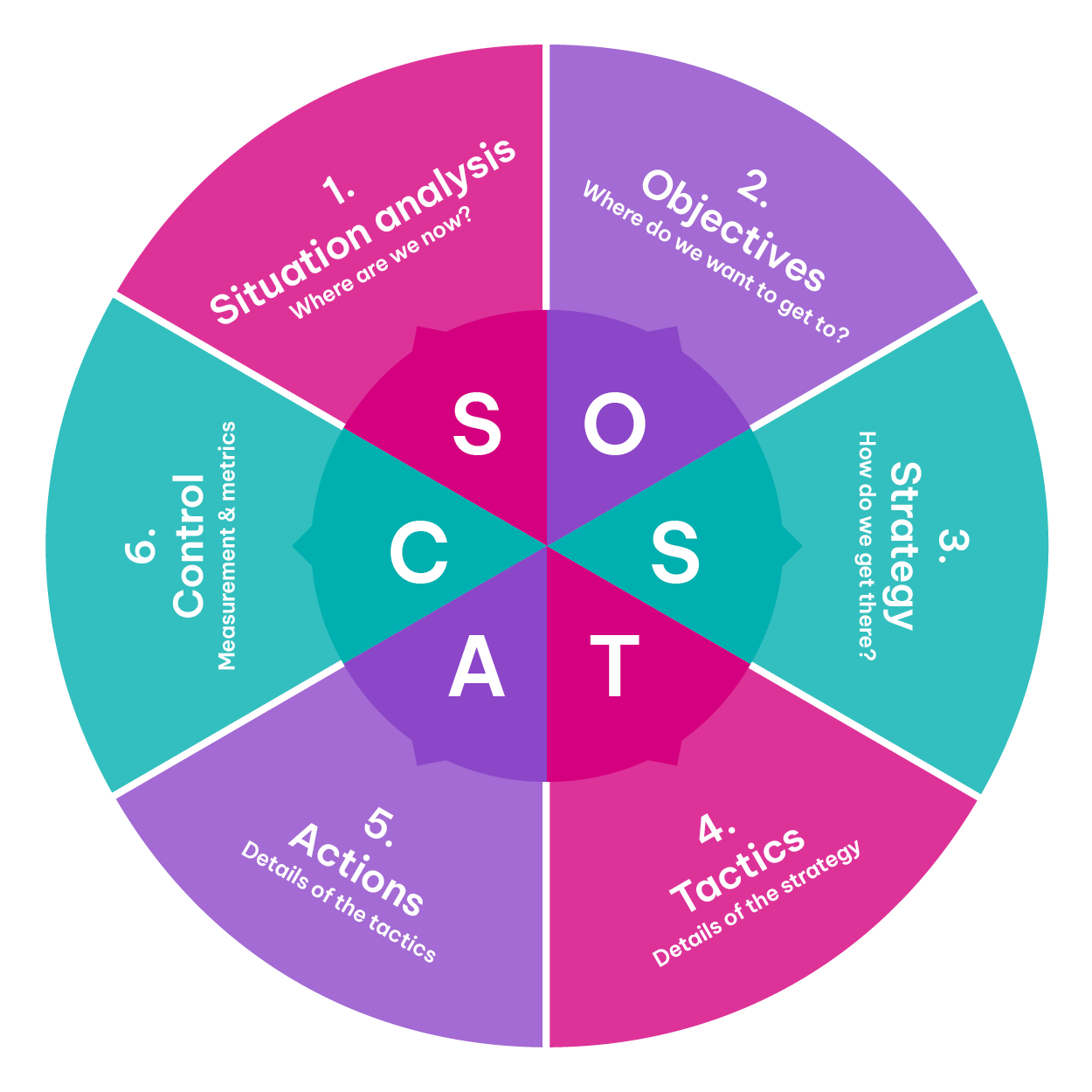
A marketing strategy might be formally defined annually. Your analysis shouldn’t be. The measurement of the activity you undertake needs to continuously inform what you do next.
PR Smith’s SOSTAC® model is useful here. Situation Analysis establishes where you are now; Objectives define where you want to go; Strategy and Tactics establish how you will get there; Actions cover delivery; and Control measures whether it is working and that measurement needs to be continuous.
If you wait until your annual strategy day to discover that something has changed or stopped working, you’re too late.
At Transform, we say strategy informs the plan. It’s the plan that needs to be flexible enough to change.
And your measurement needs to look beyond your own numbers. What are competitors doing? What has changed in the market? What are customers responding to? Are new channels or technologies changing behaviour?
What should you be doing differently as a result?
We were once presented with what could loosely be termed a marketing strategy. It was for a solar business that had an exceptional proposition to commercial markets.
Their marketing strategy was a PowerPoint deck that was 152 slides long. It contained every possible thing the business could do. Every channel. Every medium. Every opportunity. There was no investigation. No analysis. No integration.
And it was no wonder the team felt completely overwhelmed and had absolutely no idea what was working and what wasn’t. More activity does not make a better strategy.
A good strategy should help you prioritise. It should make it easier to decide where to invest your time, money and energy – and, just as importantly, what not to do.
If everything is a priority, nothing is.
This leads to another mistake we see regularly. Every marketing channel being treated separately. Whether you have an in-house marketing team, use external specialists or work with several agencies, a lack of coordination wastes both time and resources.
We worked with a brilliant marketing team that had so many agencies they spent almost all of their time in meetings managing them. There is absolutely nothing wrong with working with specialists. In fact, we fully endorse it. No single person can be an expert in every marketing discipline.
But get the experts in the same room and make sure they are working to the same strategy.
The point isn’t that every discipline should do the same thing. It is that they should all be working from the same strategic direction.
We explore that in more detail in Create it once. Use it multiple times: why integrated marketing creates more cut-through.
There is rarely one single reason a marketing strategy stops performing. More often, it happens gradually. The market changes but the strategy doesn’t. Activity accumulates. Measurement becomes retrospective. Priorities multiply. Channels start operating independently.
A good strategy needs to give the business direction, but it also needs to remain relevant to what is happening around it.
So ask yourself: are you still making deliberate choices about where to focus? Are you measuring what matters? Are your teams and agencies working towards the same objective? And are you prepared to stop doing things that are no longer delivering?
We’ve drawn these insights from 20 years of developing and delivering marketing strategies across different industries and sectors. We’ve seen how quickly good marketing can lose its impact when the strategy becomes static, overloaded or disconnected.
If some of this feels familiar, get in touch. We can review your current strategy, challenge what is no longer serving the business and identify where changes could improve focus and performance.
We love a chat and a challenge.
We're always up for a coffee and conversation.
Fill in the form, drop us a line at info@transformcomms.co.uk,
or call us on 01225 863846.
Let’s transform.
Together.


